
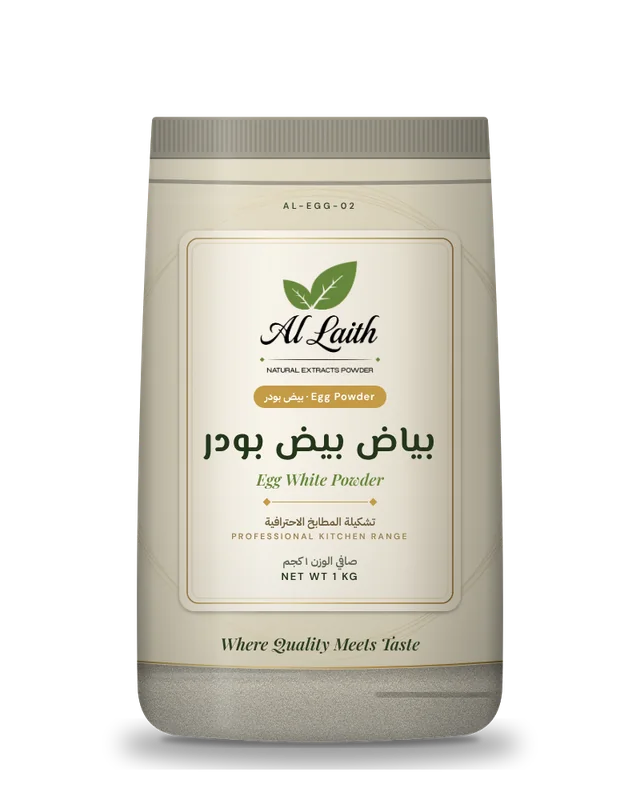
What is egg white powder?
Egg white powder is real chicken egg white with the water removed, leaving a fine white powder. It is also sold as dried egg white, albumen powder or powdered egg white. You turn it back into liquid white whenever you need it, with no cracking, separating or leftover yolks.
How to prepare it
The ratio is simple: 1 kg powder + 7 L water = 8 kg liquid egg white.
- Pour the water into a clean bowl.
- Sprinkle the powder in gradually while stirring slowly so it does not clump.
- Let it rest until fully dissolved, then use it like fresh egg white.
- Prepare only what you need; refrigerate any prepared white like normal egg white.
Uses in restaurants
- Coating: helps breading stick to chicken, fish and escalope.
- Binding: binds and holds water in minced meat and fish products such as kofta and fish fingers.
- Egg-white omelettes: no separating needed.
Uses in pastry and bakeries
- Meringue and pavlova: whips into a stable foam.
- Mousse and soufflé: adds lightness.
- Sponge cakes and doughs.
For desserts or for coating?
The same product works for both at the same ratio (1 kg + 7 L water). For desserts, whisk it in a clean, grease-free bowl; for coating and binding, use it liquid, or with slightly less water for a thicker layer. The Al Laith team can help you set the method for your dish.
Why restaurants prefer it
You prepare only what you need, store it dry without a fridge before mixing, avoid breakage and shells, and cost every plate by the gram.
Quick quantity table
| Liquid white needed | Egg white powder | Water |
|---|---|---|
| 1 kg | 125 g | 875 ml |
| 2 kg | 250 g | 1.75 L |
| 4 kg | 500 g | 3.5 L |
| 8 kg | 1 kg | 7 L |
Stable meringue from egg white powder
- Reconstitute and make sure the powder is fully dissolved.
- Use a clean, completely grease-free bowl.
- Whisk on medium speed until a light white foam forms.
- Add the sugar gradually and raise the speed until you reach the texture you need.
- Pipe or bake as usual.
Because you prepare exactly what each batch needs, there are no leftover yolks and no wasted whites — a real saving for pastry shops working daily volumes.
Who uses albumen powder?
- Pastry and dessert shops: meringue, pavlova, mousse, glazes.
- Bakeries: sponge cakes and some doughs.
- Fried-chicken and escalope restaurants: a binding layer before breadcrumbs.
- Fish restaurants: binding fish fingers and minced fish, coating before frying.
- Cafés and hotels: egg-white omelettes at breakfast.
- Cloud kitchens and caterers: fixed quantities and easy storage.
Common mistakes
- Dumping the powder in at once — sprinkle it onto the water.
- Whisking in a greasy bowl — the foam will not rise.
- Leaving a big prepared batch out of the fridge — treat it like fresh white.
- Leaving the bag open — the powder absorbs moisture and clumps.
Storage after opening
Close the bag tightly or move the powder to an airtight tub, and keep it in a cool, dry place away from sunlight and heat. Always use a dry scoop. The 15 and 25 kg bags suit kitchens with daily use; the 1 kg pack suits trials and small branches.
Packs and delivery
Available in 1 kg packs and 15 and 25 kg bags, delivered across Egypt. Send us your quantity and use on WhatsApp for a quotation.
Frequently asked questions
How do I prepare egg white powder?
Mix 1 kg of powder with 7 L of water to get 8 kg of liquid egg white, adding the powder gradually while stirring.
Is albumen the same as egg white powder?
Yes. Albumen, dried egg white and egg white powder are names for the same product.
Does egg white powder whip for meringue?
Yes. Reconstituted at 1 kg + 7 L water it whips into a stable foam for meringue and pavlova, as long as the bowl is clean and grease-free.
More articles you may find useful
- How to Reconstitute Egg Powder: Water Ratio Table
- Egg Powder vs Fresh Eggs: A Restaurant Comparison
- Egg Powder for Restaurants: Mixing Ratios, Uses & Storage
- Powder Sauces for Restaurants: Cheddar, Demi-Glace, BBQ
Egg White Powder — see the product page and request a quote on WhatsApp.